Born in Beijing in 1957, Ai Wiewei is a conceptual artist and important Chinese and international cultural figure. His life experience includes living a cave with his family in exile, studying film in Beijing, studying in New York for 10 years, spending 8 months in Chinese prison, relocating to Berlin and, most recently, to Cambridge. His experience is vast and this comes across in his work, which reflects on such themes as history, authority and communication. While his practice is research intensive it also depends on craftsmanship and a diverse range of media and processes – it encompasses protest art, architecture, public art, ceramics, internet art and performance among others.
With regards to freedom of speech his cultural contributions have been recognised by human rights organisations, winning the Vaclav Havel Prize for Creative Dissent in 2012 and Amnesty International’s Ambassador of Conscience Award in 2015.
Works include:
Dropping a Han Dynasty Urn (1995), Study of Perspective (2005) – both performative acts of defiance against authorities of history, taste, wealth, politics.
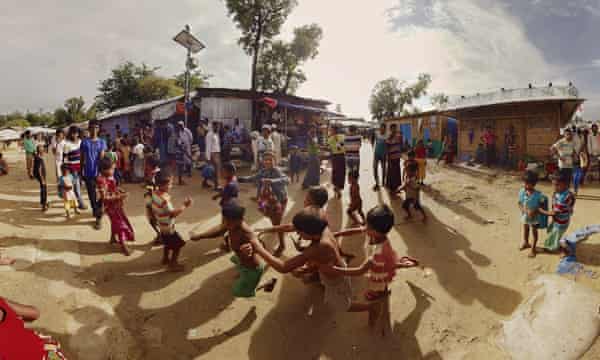
Omni (2019) a 360 degree documentary filmed in Myanmar, placing the viewer in the virtual centre of their ecological and refugee crises (it’s slow but by using real-time VR he wanted to provide a ‘migrants’-eye view of daily activities – reality goes at it’s own pace, it’s not edited – there is a sense of reality but there is also the sense we’re just watching). Omni was produced with Acute Art – a group that works with artists to make virtual and augmented reality videos.
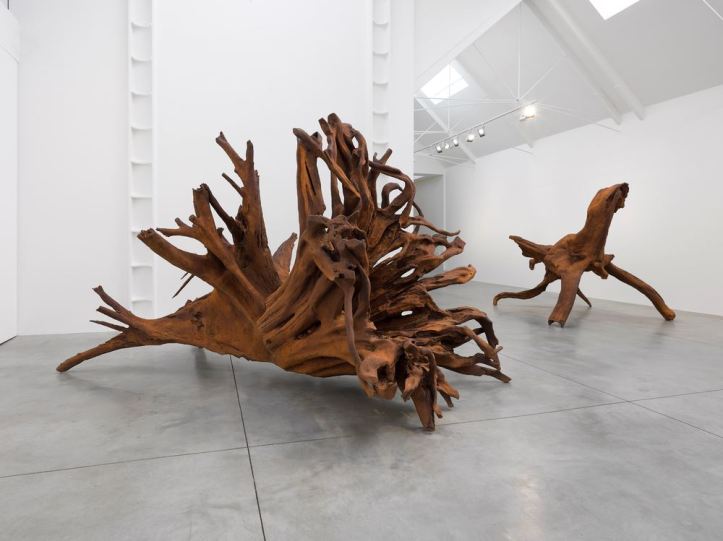
Roots (2019) – Ai has an interest in universal symbols, here it is the tree, with its upturned roots the physical artwork. [[His multi-faceted approach to this project is how I had intended to approach the Stream project – exploring visual features and symbolic/linguistic associations – but I didn’t spend enough time on process or making – the salmon drawings were an initial attempt to just make but ended quite quickly. I was then drawn away from the natural connotations of the word towards social media and so the project became more one dimensional.]]
His choices of subject, material and space are often politicised – for Trace (2014), an exhibition held in Alcatraz, he (with 100 or so staff) presented portraits of political prisoners made out of LEGO. The bulk buying of the LEGO itself became a political issue, as the company initially refused to supply projects with political agendas (after pressure they ended up changing their policy).
Hansel & Gretel (2017) // Ai Weiwei, Jacques Herzog and Pierre de Meuron

This is the project that relates most directly to mine – concerns are similar and it offers good ideas for development and reflection. A collaboration with architects Herzog and de Meuron, this worked as an immersive installation piece covering an indoor area of 55,000 square feet in Park Avenue Armoury, New York. From moment of entry everyone is tracked by drones and 56 computers with infrared cameras. These project bird’s eye images of visitors onto the ground beneath them, like digital shadows.
Despite the oppressive surveillance set-up people are having fun, using their phones to capture the experience. They know they are being watched but because they’re having fun they don’t care – the work makes evident how we trade our privacy for fun. As Herzog explains, we’re all complicit in this, we’re not just victims.
‘Every time we use services like Instagram or Snapchat, we voluntarily give up our data in exchange for entertainment.’
In 2012 Ai played with how he himself had been surveilled by the Chinese government, broadcasting four live webcams from his house to weiweicam.com before being shut down within two days.
I have not involved data privacy in my Instagram project but it’s definitely an important issue – what I have done is download my personal data from Instagram onto my laptop – it’s not very interesting and all appears to be information/activity I already knew they had, this perhaps only proves Herzog’s point – we don’t know to what extent its used and we don’t really care (who has the time to care?).

I have an idea to subvert personal data collection by creating another online persona through fake social media accounts – to what extent could this subvert personal data? how much would I have to modify my internet usage to throw it off? would it need to be a persona quite different from my own?
Also interesting to consider the role of the gallery/museum in data collection and analysis – institutions very much interested in what audiences prefer and very much interested in demographics (young and insta-famous ideally). Habitual uploading on instagram is the perfect way for them to find out. There’d certainly be ways to address and subvert this – refusal to take photos in galleries? posting up their data policies/my own personal data on their walls? taking hundreds/thousands of photos of the things they wouldn’t want you to/wouldn’t expect you to – toilets, floors, bare walls, windows, problems?
It’s no longer so much about how a work fits into the physical gallery, but how it appears on Instagram and Twitter.
https://www.lissongallery.com/artists/ai-weiwei
https://www.theguardian.com/artanddesign/2020/mar/22/ai-weiwei-an-artist-must-be-an-activist
 calummartin